

Before signing a lease agreement in Serbia, whether for residential or commercial property, there are essential details every potential tenant and landlord should understand when leasing real estate in Serbia. Leasing property in Serbia involves more than just monthly payments – it includes legally binding responsibilities that could significantly impact your rights and financial obligations. Understanding these details can make leasing real estate in Serbia a straightforward process, while ignoring them may lead to unwanted surprises.
Who Should Read This Blog on the Lease Agreement in Serbia?
This guide is for anyone considering a property lease in Serbia, from individuals looking for a new home to businesses seeking an office space.
Here, we’ll cover the essentials you should know about lease agreement in Serbia, including who can enter these contracts, what legal framework regulates lease agreement in Serbia, and critical terms related to lease duration, payment, security deposits, and more. By the end, you’ll have a comprehensive understanding of the practical and legal aspects of leasing property in Serbia.
- The Lease Agreement in Serbia – General Considerations
- Duration and Termination of the Lease Agreement in Serbia
- Security Methods and Flexible Rent Structures
- Condition Report and Maintenance Responsibilities in Lease Agreement in Serbia
- Sublease Rights in Serbia
- Tax Implications for Lease Agreements in Serbia
- Benefits of Owning, Leasing Real Estate, and Doing Business in Serbia
The Lease Agreement in Serbia – General Considerations
Definition and Parties Involved
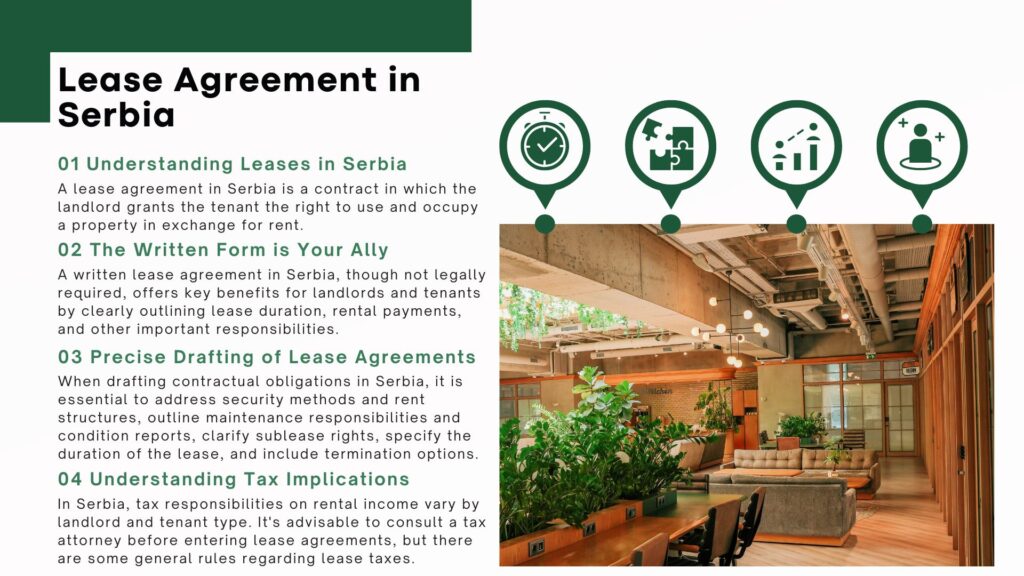
A lease agreement in Serbia is a legally binding contract in which one party, known as the landlord, grants another party, referred to as the tenant, the right to use and occupy a property for a specified duration in exchange for a predetermined payment, typically known as rent. This arrangement is foundational in the realm of real estate, facilitating the relationship between property owners and those seeking temporary possession of the property.
Lease agreements in Serbia can encompass various types of properties, including residential homes, commercial spaces, and industrial facilities, making them relevant for both individuals and businesses.
As such, both private individuals and corporate entities can be involved as parties to a lease, each bringing their own needs and expectations to the agreement.
Regulatory Framework for the Lease Agreement in Serbia
Lease agreement in Serbia is primarily governed by the Law on Obligations[1]. Though verbal leases are possible and fully valid, written contracts are highly recommended to provide predictability in obligations, proof of authorized parties entering the contract, and clear evidence of the lease’s duration.
The Importance of Written Form for the Lease Agreement in Serbia
Although a written lease agreement in Serbia is not legally required, it offers numerous advantages that can significantly benefit both landlords and tenants. A written lease agreement serves as a comprehensive record of the terms that have been mutually agreed upon, detailing essential aspects such as the:
- contracting parties and their representatives,
- the property being leased,
- amount of rent,
- the payment schedule,
- lease term,
- and any specific conditions or obligations.
Written lease agreement in Serbia allows both parties to verify their respective rights and responsibilities, fostering transparency and reducing the likelihood of misunderstandings.
Moreover, having a written contract acts as a crucial legal safeguard in the event of disputes. Should any issues arise, such as disagreements over payment, property maintenance, or the conditions of occupancy, a written lease serves as a definitive reference that can help resolve conflicts efficiently.
Overall, while a verbal agreement may suffice in certain situations, the advantages of a written lease agreement cannot be overstated, making it an essential tool in the leasing process.
Duration and Termination of the Lease Agreement in Serbia
Fixed-Term vs. Indefinite Leases
Fixed-term leases typically have a specified duration, such as one year or more, and automatically terminate upon expiration without requiring additional notice. This type of lease provides both the landlord and tenant with certainty regarding the length of the rental arrangement, allowing them to plan accordingly.
On the other hand, indefinite leases do not have a predetermined end date, which means they can continue until one party decides to terminate the agreement. In such cases, either the landlord or the tenant must provide proper notice to end the lease agreement in Serbia and respect the termination term. This type of lease offers greater flexibility, as tenants can remain in the property for as long as they wish, provided they adhere to the lease’s terms.
Termination and Notice Periods
A lease agreement whose duration is not specified, nor can it be determined from the circumstances or local customs, terminates upon notice of termination, which either party may give to the other, subject to a specified notice period. If the notice period isn’t specified in the lease agreement, an eight-day notice is prescribed by law, unless the timing is deemed inconvenient. However, defined notice periods are often preferred, as they provide tenants with the necessary time to secure alternative accommodations or space.
Additionally, some agreements may include automatic renewal clauses or grant tenants unilateral rights to renew the lease if they provide notice within a specified timeframe before the lease’s expiration.
Incorporating clear notice periods and renewal options can significantly enhance the leasing experience for both landlords and tenants.
Security Methods and Flexible Rent Structures
Forms of Security
Leases typically involve a security deposit, which serves as a safeguard against potential damages to the property or unpaid rent. This deposit is often required upfront and can be used to cover any costs incurred due to the tenant’s actions or failure to meet their rental obligations.
In addition to security deposits, alternative forms of securing a lease, such as promissory notes and bank guarantees, are also commonly utilized, especially in commercial lease agreements in Serbia.
Adjustable Rent
Many leases specify a fixed rent amount while also including provisions that allow for adjustments based on inflation or changes in consumer prices. This flexibility is particularly important in today’s fluctuating economic conditions, as it helps protect the interests of both the landlord and the tenant.
By incorporating these adjustment mechanisms, landlords can ensure that their rental income keeps pace with rising costs and inflation, thus maintaining the property’s value over time. At the same time, tenants benefit from knowing that their rental obligations can be aligned with current economic realities, helping them manage their budgets more effectively.
Such provisions create a more equitable arrangement, allowing both parties to adapt to market changes while minimizing the risk of disputes.
Lease Agreement Without Compensation
Lease agreements in Serbia without compensation are also quite common, particularly in the context of virtual office services when the tenants are legal entities. However, the Serbian Tax Authority may view these agreements as lacking genuine economic interest, which could imply tax avoidance or unreported income. Therefore, it is important to establish an optimal rent amount to avoid issues during tax audits, especially when dealing with legal entities as tenants.
On the other hand, when it comes to entrepreneurs (individuals registered in Serbia for conducting business) there is a slight difference. Generally, the Serbian Tax Authority permits free leases only when the property owner is a relative of the entrepreneur, providing a valid justification for the absence of rent.
In other cases, the Serbian Tax Authority views such lease agreements as lacking economic interest, which requires tax calculations and payments related to the lease.
Condition Report and Maintenance Responsibilities in Lease Agreement in Serbia
Condition Report (Handover Protocol)
Upon taking possession of a rental property, a detailed condition report serves as a crucial document that helps to accurately document the state of the property and any items included in the lease. This report is beneficial for both the beginning and the end of the lease term, as it establishes a clear baseline of the property’s condition.
By thoroughly documenting the existing state of the property, including any pre-existing damage or wear and tear, both the landlord and tenant can address potential discrepancies that may arise later. This not only protects the interests of both parties but also helps to avoid disputes over security deposits and repair responsibilities at the end of the lease.
Maintenance and Upkeep
Under Serbian law, the landlord is responsible for keeping the property in good condition throughout the lease term and must carry out necessary repairs. The landlord is also required to reimburse the tenant for maintenance expenses that the landlord was obligated to cover. However, minor repairs due to regular use, along with general usage costs, are the tenant’s responsibility.
The lease agreement in Serbia should outline who is responsible for ongoing maintenance, utility payments, and repairs. Regular maintenance is generally the tenant’s duty, while landlords cover extraordinary repairs and other larger upkeep issues.
The bottom line is that clear terms of the lease can prevent misunderstandings regarding repair responsibilities and associated costs.
Sublease Rights in Serbia
Subleasing Permissions
The ability of a tenant to sublease a property in Serbia should be clearly articulated in the lease agreement. Subleasing can provide flexibility for tenants facing changing circumstances, but it is essential that such arrangements comply with the landlord’s consent and the terms of the original contract to avoid any breaches.
Subleasing Regulations According to Serbian Law
Under Serbian law, unless otherwise specified in the lease agreement, a tenant is allowed to sublease the rented property or grant its use to another party, as long as it does not cause any harm to the landlord. The tenant is also responsible for ensuring that the subtenant uses the property in accordance with the original lease terms.
If the landlord’s consent is necessary for subleasing, they can only refuse such permission for legitimate reasons. Additionally, the landlord has the right to terminate the lease if the tenant subleases the property without their consent – when such consent is required by law or the lease agreement.
Also, it is important to note that any sublease automatically ends when the original lease is terminated!
In conclusion, tenants must clearly outline their sublease rights in the lease agreement in Serbia and adhere to legal requirements to ensure compliance and protect both their interests and those of the landlord.
Tax Implications for Lease Agreements in Serbia
In Serbia, tax responsibilities on rental income vary depending on the type of landlord and tenant. While it is always advisable to consult a tax attorney before entering into lease agreements in Serbia, here are some general rules regarding lease taxes:
- If the landlord is an individual (natural person), then the legal entity or entrepreneur leasing the property is required to file the tax return and pay the tax on behalf of the individual landlord.
- If both the landlord and the tenant are individuals (natural persons), then the landlord is generally responsible for the tax obligation on rental income.
- In cases where both the tenant and the landlord are a legal entity or an entrepreneur, the landlord is generally responsible for managing rental income taxes as part of their business income.
The tax rate for income tax on real estate for individuals is 20%, calculated on the gross amount reduced by 25%.
Recognizing these variations in tax obligations is crucial for both landlords and tenants, as it helps ensure compliance and minimizes the risk of penalties.
Additionally, these rules are often modified by the lease agreements in practice, making it important to understand how they can be altered and which rules will apply in the absence of a different agreement.
Benefits of Owning, Leasing Real Estate, and Doing Business in Serbia
Serbia’s growing real estate market has established the country as an attractive destination for investment, offering various opportunities for both temporary and permanent residency through property purchases, in addition to avenues like company formation in Serbia.
The increasing demand for real estate has made it crucial for investors to understand the legal aspects of lease agreements, as clear and specific contracts help protect the rights of both landlords and tenants. This clarity not only enhances the security of real estate transactions but also contributes to a more stable and trustworthy environment for investment, enabling all parties to navigate their rights and responsibilities effectively.
[1] Law on Obligations (“Official Gazette of SFRY,” no. 29/78, 39/85, 45/89 – decision of the Constitutional Court, and 57/89; “Official Gazette of FRY,” no. 31/93; “Official Gazette of SCG,” no. 1/2003 – Constitutional Charter; and “Official Gazette of RS,” no. 18/2020)