

In this blog, we will provide detailed answers to the 50 most frequently asked questions we encounter as a law firm regarding establishing and operating a company in Serbia. We will cover topics such as the company formation process, obtaining necessary permits and licenses for business activities, employment and tax law issues, foreign exchange regulation, and other key matters essential for investing and running a business in Serbia.
Please note that this is an informational blog and cannot serve as a substitute for legal advice tailored to your specific situation. In this blog we aim to help you better understand the general legal framework and opportunities for doing business in Serbia.
- On Incorporating a Company in Serbia
- Should we establish a branch office, an LLC, or a sole proprietorship in Serbia?
- What minimum equity is required to set up a company in Serbia (LLC)?
- What is the timeline for depositing minimum equity into the company in Serbia?
- Can the company's owner in Serbia be a natural person or a legal entity?
- What are the minimum requirements for shareholders, and are there any restrictions for companies that include a foreign shareholder?
- Is having a manager or director in the company in Serbia mandatory?
- Who can act as a legal representative of the company in Serbia? Can they be a local or foreign national?
- How can I hire a director for my company in Serbia and does the director need a residence or work permit?
- Who can hold a power of attorney in Serbia for registering the Company in Serbia?
- Are there any restrictions on the business activities that foreign or foreign-owned companies can engage in Serbia?
- What steps are involved in registering the company in Serbia, and how long does the process typically take?
- What corporate documents exist for the company in Serbia?
- Are there any mandatory local partnership requirements for foreign-owned companies in Serbia?
- Can the company’s registered address be a virtual office, or is a physical presence required?
- How can I recapitalize and increase the registered capital of a company in Serbia?
- On Licensing and Compliance
- On Taxation and Financial Compliance
- What are the corporate tax rate, associated costs, and compliance requirements?
- What are the VAT rates, threshold requirements, and other VAT-related compliance for companies in Serbia?
- What are the rules and limitations for profit repatriation from Company in Serbia?
- Does Serbia have a Double Taxation Avoidance Agreement (DTAA) with my country?
- Are there any tax incentives or benefits for foreign investors or businesses?
- Are there withholding taxes on payments such as dividends, interest, or royalties to foreign entities?
- On Banking and Financial Setup
- What is the process for opening a corporate bank account in Serbia and what documents are typically required?
- Who can act as an authorized signatory for the bank account and who can use online banking?
- How much time is typically required to open a corporate bank account?
- What are the charges for outsourced bookkeeping services?
- Is there a requirement to maintain a minimum balance in the bank account?
- On Operational Setup and Shares Transfer
- Is it mandatory to have office space to register a company in Serbia?
- What are the typical costs for renting office space in Serbia?
- What are the estimated costs for setting up a business?
- What is the process for registering with the Serbian Chamber of Commerce?
- Is it mandatory to work with a local accounting firm for compliance?
- How is the transfer of shares in a Serbian company conducted, and what are the legal requirements for running a company in Serbia?
- On Employment Laws and Employee Compliance
- What are the regulations for hiring employees, and do they differ for locals and foreign nationals and what is the minimum wage?
- What are the employee contract rules?
- What are the end-of-service regulations (employment termination)?
- What are the monthly compliance requirements related to employees?
- What are the regulations regarding working hours?
- What are the statutory leave entitlements, including maternity and paternity leave?
- Are there any training or safety compliance requirements for employees?
- Ecology, Foreign Exchange Regulations, and Intellectual Property in Serbia
- Overview of the Business Climate and Environment in Serbia
- What type of legal system does Serbia have?
- What is Serbia's official business language?
- What are the fiscal year requirements? Can we choose our fiscal year for the Company in Serbia?
- Are there government grants or subsidies for new businesses or foreign investments?
- Why is registering a company in Serbia an attractive option for expanding into European and global markets?
- What areas of law apply to my business in Serbia?
- What are the legal requirements for closing down a company in Serbia?
On Incorporating a Company in Serbia
Should we establish a branch office, an LLC, or a sole proprietorship in Serbia?
Limited liability company in Serbia (LLC or DOO) is the most popular form for businesses of all sizes, established by one or more founders – individuals or legal entities (companies). The main advantage of an LLC in Serbia is the limited liability of the founders/owners of the company in Serbia. This means that company shareholders risk only what they have invested in their company. The company itself, not the owners, is responsible for its obligations. In other words, this structure separates founders’ assets from the company’s assets. LLC in Serbia receives a company registration number, tax identification number, registered office address, and other essential business details. Consequently, the LLC is Serbia’s safest and most commonly used business structure.
The branch of a Foreign Company in Serbia allows foreign companies to operate in Serbia without establishing a company in Serbia. It is an organizational part of the foreign company operating in Serbia. Such a Branch Office operates under the same legal identity as its parent company. Banking regulations consider branches as residents and allow them to open resident bank accounts. For this reason, foreign companies often register their branch in Serbia. A Branch does not have a separate legal personality, which makes the parent foreign company liable for its obligations, contrary to the LLC. In Serbia, branches are not considered legal entities, so they are not required to withhold tax on payments to non-residents, including profit transfers or service fees.
The sole proprietorship is not a separate legal entity – the business and the owner are legally the same, meaning the owner is personally liable for all business obligations. A sole proprietorship (“preduzetnik” or “PR”) is one of the simplest forms of business registration in Serbia, ideal for individuals seeking to operate independently. It is particularly suitable for small and medium-sized businesses due to its straightforward establishment process and low administrative requirements. Sole proprietors can choose between a flat-rate taxation scheme (if eligible) or standard taxation based on actual income and expenses. The flat-rate option simplifies tax obligations and is popular among small businesses. Ultimately, entrepreneurs in Serbia should pay close attention to the independent contractor test.
What minimum equity is required to set up a company in Serbia (LLC)?
The minimum equity required for setting up a company in Serbia amounts to RSD 100 (approx. EUR 1)
What is the timeline for depositing minimum equity into the company in Serbia?
You can choose to deposit founding capital within five years following company registration (LLC). Entrepreneurs do not have the minimum funding capital.
Can the company’s owner in Serbia be a natural person or a legal entity?
Yes, the company’s owner in Serbia can be either a natural person and/or a legal entity.
What are the minimum requirements for shareholders, and are there any restrictions for companies that include a foreign shareholder?
There is no limit to the number of shareholders. There are no limitations such as the nationality, or place of registration.
Companies in Serbia are required to submit periodical reports to the National Bank of Serbia if their shareholder structure includes a foreign individual or company.
Is having a manager or director in the company in Serbia mandatory?
The company in Serbia must have at least one company director who acts as the company representative. Company director is named within the company’s Articles of Incorporation (founding act), adopted by the company shareholders.
Who can act as a legal representative of the company in Serbia? Can they be a local or foreign national?
In Serbia, domestic and foreign company founders and directors have equal rights. As a result, foreigners can fully establish a company and act as representatives of a Serbian company. In other words, your Serbian company does not require Serbian citizens to be representatives or founders at any time.
In addition to one or more directors, companies in Serbia can have other representatives and procurators, who represent the company within the scope of the authority granted to them in accordance with the company’s decision and the law.
How can I hire a director for my company in Serbia and does the director need a residence or work permit?
a) Management Agreement – This agreement does not establish an employment relationship, and the director receives a specified compensation. If a foreign national intends to stay in Serbia for more than 90 days within a 180-day period, they must obtain a temporary residence permit.
b) Employment Agreement – This creates an employment relationship, and the director receives at least the minimum wage (approximately EUR 750 gross / EUR 500 net). In this case, the director must obtain both a work permit and a residence permit.
Who can hold a power of attorney in Serbia for registering the Company in Serbia?
Whether you’re starting a company in Serbia or seeking other legal services, the legal profession represents an independent and autonomous service providing legal assistance to individuals and legal entities under Serbian law. The unauthorized provision of legal aid constitutes a criminal offense in the Republic of Serbia. In addition to the aforementioned description of the activities that fall within the legal profession, lawyers are highly qualified professionals and are responsible for providing legal assistance to clients, They are required to adhere to the code of professional ethics for lawyers, which, among other things, serves to maintain the standard of conduct and an adequate level of service provided by lawyers to clients.
Are there any restrictions on the business activities that foreign or foreign-owned companies can engage in Serbia?
For most industries, Serbia is open to foreign investment, and foreign companies can operate freely under the same conditions as domestic businesses. Foreign companies may face restrictions or require special permits to operate in industries related to defense, weapon manufacturing, or military services. Generally, companies with foreign capital can operate freely under the same conditions as domestic businesses.
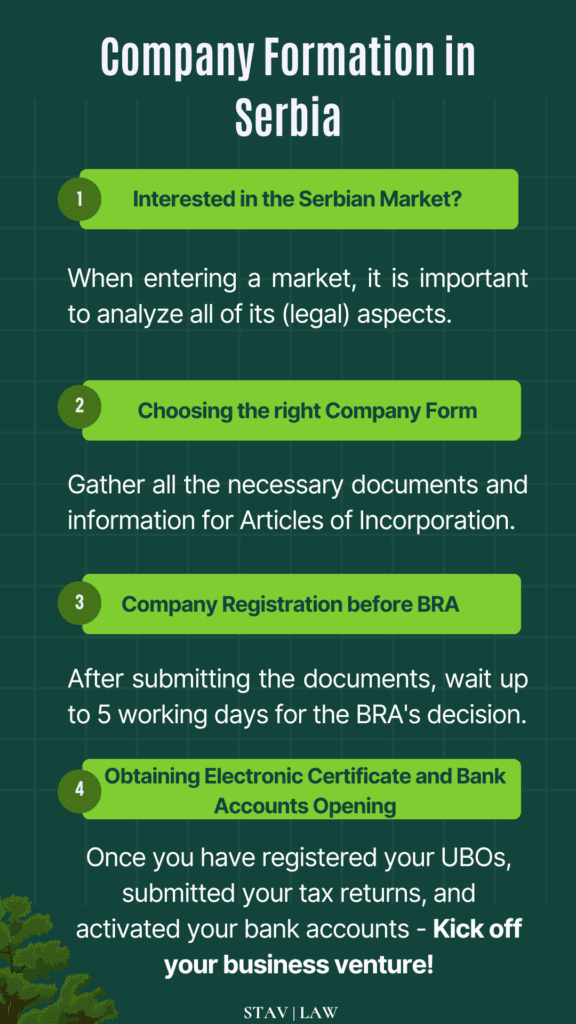
What steps are involved in registering the company in Serbia, and how long does the process typically take?
The steps involved in registering the company in Serbia involve:
- Choosing the right company form;
- Gathering the necessary documents and information to draft the Articles of Incorporation;
- Company registration before Business Registers Agency (BRA): BRA issues its decision within 5 working days after submitting the documents.
- Following the company registration in Serbia, you will need a Serbian electronic certificate. An electronic certificate is essential for secure electronic communication with Serbian authorities. Following registering your company in Serbia you must obtain an electronic certificate from the company’s director.
- The company director needs the certificate to register the company’s beneficial (ultimate) owners (UBOs) in the Central Register of Beneficial Owners maintained by BRA within 30 days.
- LLCs must submit their tax returns within 15 days after they register. Thus, selecting a reliable accountant or accounting agency is crucial for effectively managing bookkeeping and tax submissions.
- Bank Account Opening: In Serbia, there is a wide range of domestic and international banks, each offering various services, including account management, loans, and additional financial products.
Once you have registered your UBOs, submitted your tax returns, and activated your bank accounts, the company incorporation process is usually finished. The smooth process typically takes 10 – 30 days, depending on the involved parties and particular circumstances.
What corporate documents exist for the company in Serbia?
- Articles of Incorporation: The Articles of Incorporation (founding act) is a mandatory document that outlines the company’s legal structure, including its name, registered office, activities, registered capital, and the distribution of shares. It is required for company registration with the Serbian Business Registers Agency.
- Shareholders’ Agreement: A Shareholders’ Agreement is a private contract between the company’s shareholders that regulates internal governance, decision-making processes, rights, and obligations, such as voting rights, profit distribution, and share transfers. This document is not mandatory for registration but is commonly used to manage the relationship between shareholders and avoid disputes.
In summary, the Articles of Incorporation are a public, mandatory document, while the Shareholders’ Agreement is a private, optional document for regulating shareholder relations.
Are there any mandatory local partnership requirements for foreign-owned companies in Serbia?
In Serbia, such requirements do not exist for most industries. Companies with foreign shareholders can generally operate independently without the need for a local partner.
Can the company’s registered address be a virtual office, or is a physical presence required?
In Serbia, companies can use a virtual office as their registered address by entering into a specific lease agreement. Specialized service providers often provide this and is commonly used by startups, foreign companies, or businesses that do not require a physical office. Tax or other authorities may sometimes request proof of actual operations at the registered address. Therefore, it is essential to comply with local laws, ensure all relevant documents are available at the registered address, and possess a valid lease agreement with the virtual seat service provider.
Suppose you use multiple business premises, warehouses, or other facilities for your business. In that case, you must register the additional address with the Business Registers Agency or the Tax Authority, depending on the type of business premises.
How can I recapitalize and increase the registered capital of a company in Serbia?
A company in Serbia can improve its financial position through recapitalization or by increasing its registered capital in many ways, some of them being the following:
- Recapitalization of a company in Serbia
- Founder’s Loan: Founders can lend funds to the company via a loan agreement, recorded in the financial statements, without increasing the registered capital.
- Additional Payments: Founders can make additional contributions without changing the registered capital.
- Increase of Registered Capital
- Injection of New Funds: Shareholders can contribute additional funds or assets to the company.
- Debt-to-Equity Conversion: Existing debts owed to creditors or founders can be converted into equity, thus increasing the company’s registered capital.
- Admission of New Shareholders: New shareholders can join the company by contributing funds or assets in exchange for equity.
On Licensing and Compliance
Are there any special licenses required for operation in Serbia?
Generally, most activities do not require obtaining a license or permit from a government authority. There is an obligation to obtain a permit, or a license from a government authority for certain activities. Some licenses must be obtained before the company’s establishment, while others are required after its establishment but before commencing business activities. In such cases, direct or indirect inspections of documentation, personnel, technical requirements, or other conditions are typically conducted to secure the necessary permit for performing the activity.
In Serbia, there is no precise list of business activities or operations that require a license. Therefore, before starting a business activity, it is necessary to analyze the relevant regulations and contact the competent state authorities to determine whether a license is required for the specific activity.
Are import/export licenses mandatory for certain activities?
These licenses are required for goods or services regulated due to their nature, such as goods subject to government controls, such as weapons, pharmaceuticals, chemicals, precious metals, agricultural products, tobacco products, etc.
On Taxation and Financial Compliance
What are the corporate tax rate, associated costs, and compliance requirements?
In Serbia, the corporate tax rate is 15% on taxable profits. The taxable profit is calculated as the company’s income minus allowable expenses, such as operating costs, wages, and other deductions.
Regarding compliance requirements, businesses in Serbia must file annual financial statements to declare their taxable profits and calculate the amount of tax owed. This must be done by March 31st for the previous year.
What are the VAT rates, threshold requirements, and other VAT-related compliance for companies in Serbia?
Value Added Tax (VAT) in Serbia is an indirect tax applied to selling goods and services. VAT is the primary form of consumption taxation, and VAT payers are businesses and legal entities engaged in certain activities within Serbia. The standard VAT rate in Serbia is 20%, which applies to most goods and services. There is also a reduced rate which applies to certain products and services.
VAT payers must keep records of the sale of goods and services, issue invoices with VAT, and pay the VAT they have collected based on their sales, reduced by the VAT they have paid on their purchases (input VAT). Any company with a turnover considered to be made within Serbia exceeding 8 million dinars (approx. EUR 68.000) within the previous 12 months is required to register for VAT.
VAT is also usually paid on imported goods. The importer is required to pay VAT on the customs value, including customs duties and other costs associated with the importation. Serbia applies the principle of VAT exemption for exports, meaning that VAT is usually not charged on the export of goods and services, while VAT is applied to imports at the standard rate.
VAT in Serbia is a complex system that requires careful tracking and compliance with legal obligations.
What are the rules and limitations for profit repatriation from Company in Serbia?
Foreign investors and companies are allowed to repatriate profits from Serbia without significant restrictions. This means companies can transfer the profits made in Serbia to their home country or another foreign country. A company in Serbia that generates profit based on financial indicators has the right to distribute the achieved profit. However, the profit is first used to cover losses carried forward from previous years, and then allocated to legal reserves. If there is any remaining profit after these allocations, it can be distributed for dividends.
The right to dividend distribution belongs to the company shareholders, based on the decision on profit distribution adopted by the company assembly at the meeting. The company assembly is a governing body composed of the shareholders (owners) of the company in Serbia. In the case of a single-shareholder company, that sole shareholder constitutes the company assembly.
The tax treatment of dividend payments includes:
- The Corporate Income Taxation, at a rate of 15%,
- Dividend Taxation:
- when paid to individuals (both residents and non-residents), at a rate of 15%,
- when paid to foreign legal entities, at a rate of 20% (withholding tax),
*Lower tax rates on dividend payments may apply only if stipulated by an international double taxation agreement.
*Payments to legal entities in tax havens are subject to a 25% withholding tax, except for dividends taxed at 20%, and service fees to such entities are taxed regardless of the service type or location.
When profit is transferred from Serbia to a foreign country, the bank or financial institution typically requires specific documentation to confirm that the payment is legitimate and that all taxes have been paid in Serbia.
Does Serbia have a Double Taxation Avoidance Agreement (DTAA) with my country?
Serbia has entered into 68 bilateral agreements with various European and other nations to prevent double taxation. You can find more information by clicking – here.
Are there any tax incentives or benefits for foreign investors or businesses?
Serbia offers a wide range of tax incentives designed to support various industries, including foreign investors. These include:
- IP BOX regime for intellectual property;
- R&D incentives for innovation-driven companies;
- Startup incentives;
- Tax benefits for employing qualified newly-hired staff;
- Tax deductions for hiring newly settled taxpayers;
- Capital gains tax benefits when intellectual property is entered into a company;
- Annual personal income tax deductions for individuals younger than 40;
- Full tax deduction for marketing-related expenses, among many other advantages;
- Other.
Are there withholding taxes on payments such as dividends, interest, or royalties to foreign entities?
Unless otherwise provided by an international treaty for the avoidance of double taxation, a withholding tax at the rate of 20% is applied and paid on the income earned by a non-resident legal entity from a resident legal entity on:
- Dividends and profit shares in a legal entity,
- Royalties from copyrights, related rights, and industrial property rights,
- Interest,
- Rent and lease payments for real estate and movable property located in Serbia,
- Payments for services such as market research, accounting and auditing, and other services related to legal and business consulting, regardless of the location where they are provided or used.
On Banking and Financial Setup
What is the process for opening a corporate bank account in Serbia and what documents are typically required?
In Serbia, there is a wide range of domestic and international banks, each offering various services, including account management, loans, and additional financial products. Generally, the bank account opening process is initiated by submitting the documentation to one of the bank’s branches. The bank then performs internal checks and informs the client about any additional documentation required or the outcome of the account opening. Banks reserve the right to refuse the request for account opening, which is their right under Serbian law.
Basic Documentation for Opening a Bank Account:
- Signed KDP Form: Signature card for the bank.
- OP Form: Signature of the company director for bank communications.
- Identification: Passport or ID card scan of company directors and owners.
- Statement on the Status of Officials: Confirmation of the director’s and founders’ status.
- Ownership Statement: Company director’s declaration regarding the company’s ownership structure.
- Bank Account Agreements: Signed agreements for both dinar and foreign currency accounts.
- Other documents, such as proof of funds, business registry excerpts, and evidence of ultimate beneficial owners (if applicable).
If the founder is a legal entity, it will be necessary to provide the bank with information about the ultimate beneficial owners of the company (UBOs), as well as the original documentation and/or statements that prove this.
The UBO (beneficial owner) is considered:
- a natural person, who indirectly or directly owns 25% or more shares, voting rights, or other rights, on the basis of which they participate in the management of the Registered Entity, i.e. participates in the capital of the Registered Entity with a share of 25% or more;
- a natural person who directly or indirectly has a predominant influence on business management and decision-making;
- a natural person, who indirectly provides or is providing funds to the Registered Entity and, on that basis, significantly influences the decision-making of the management body of the Registered Entity when deciding on financing and business operations;
- a natural person who is the founder, trustee, protector, beneficiary if designated, as well as the person who has a dominant position in the management of the trust, i.e. in another entity under foreign law;
- a natural person who is registered as the representative of cooperatives, associations, foundations, endowments, and institutions, if the authorized representative has not registered another natural person as the beneficial owner.
Who can act as an authorized signatory for the bank account and who can use online banking?
Generally, any person indicated in the signed KDP form (signature cards) can act as an authorized signatory for the bank account. KDP form must be signed by both the company director and the specified person who is the authorized signatory for the bank account.
If the director or the person authorized on the account is not present in Serbia and you wish to change the already signed KDP form, most banks allow the replacement of the KDP form through a lawyer. This process involves notifying the bank in advance about the change of the KDP form, after which the originally hand-signed form is sent by mail to the lawyer, who then performs the form replacement at the bank. This issue is separate from online banking.
The issue of online/mobile banking is separate from account opening, and the bank can issue multiple online banking accounts to different users. Additionally, numerous individuals can use a single online banking account based on mutual agreement, following the bank’s rules and procedures.
How much time is typically required to open a corporate bank account?
Depending on the complexity, whether the shareholder is a natural or legal person, the ownership chain, and the bank chosen, the process usually takes one week to one month.
What are the charges for outsourced bookkeeping services?
Accounting agency services vary depending on their internal policies and the tasks they are authorized to perform, such as the number of incoming and outgoing invoices, individual inquiries, the number of employees for whom salaries are paid, and other data relevant to the internal relationship between the accounting agency and the client.
Is there a requirement to maintain a minimum balance in the bank account?
That is not a standard practice for banks in Serbia. Depending on the bank’s internal policies, such requirements may exist. However, Serbian law does not impose such obligations.
On Operational Setup and Shares Transfer
Is it mandatory to have office space to register a company in Serbia?
The registered business address also called the company seat (information on the company address), is a mandatory requirement for company registration. Therefore, it is advisable to secure physical office space or to arrange virtual office services with a service provider in advance.
What are the typical costs for renting office space in Serbia?
The typical costs for renting office space in Serbia can vary depending on the location, size, and quality of the office, as well as the specific terms of the lease. Office rent in Belgrade, especially in prime locations like the city center, ranges from €8 to €20 per square meter per month, with higher-end office buildings potentially reaching up to €25 or more per square meter.
Additional costs may include utilities (electricity, water, heating), maintenance fees, and internet services, which can add to the overall rental expense.
Virtual office services are a cost-effective alternative when physical office space is not required, with prices typically ranging from EUR 50 to 100 per month.
What are the estimated costs for setting up a business?
Administrative fees amount to approximately EUR 150, in addition to legal services and accounting fees.
What is the process for registering with the Serbian Chamber of Commerce?
Members of the Serbian Chamber of Commerce are all business entities engaged in registered business activities within the territory of the Republic of Serbia. Hence, all legal entities become members of the Serbian Chamber of Commerce by registering with the Serbian Business Registers Agency and paying the annual membership fee.
Is it mandatory to work with a local accounting firm for compliance?
Working with a Serbian accounting or auditing firm for compliance is not strictly mandatory. However, it is highly recommended that businesses operating in Serbia engage with a local accounting or auditing firm to ensure proper compliance with Serbian tax laws, financial reporting standards, and regulatory requirements, given that the company director is responsible for the accuracy of the financial statements.
How is the transfer of shares in a Serbian company conducted, and what are the legal requirements for running a company in Serbia?
Transfer of shares in a Serbian company involves several legal steps, including drafting a transfer agreement, notarization, registration of the change with the Serbian Business Registers Agency, notifying the bank about the transfer, updating signature cards, and registering the change of ultimate beneficial owners of the company in Serbia.
Company management also involves various legal aspects, such as contract drafting, dispute resolution, and regulatory compliance. For more detailed information, visit our Running a Company in Serbia page.
On Employment Laws and Employee Compliance
What are the regulations for hiring employees, and do they differ for locals and foreign nationals and what is the minimum wage?
Every employee must have a written employment agreement outlining employment terms, including job description, working hours, salary, place of work, and other details. The standard workweek in Serbia is 40 hours, typically divided into 5 working days. Overtime is permitted under certain conditions and is paid at higher rates. Serbia has a national minimum wage, which is adjusted periodically. The minimum net wage in Serbia amounts to approx. EUR 410 in December 2024. Employers must pay the tax on salaries, and contribute to the social security system, which covers their employees’ health insurance, pension, and unemployment insurance. The gross amount for the minimal wage amounts to approx. EUR 700 (approx. 65% of the net wage).
This means that the difference between the net and gross wages consists of the employer’s contributions to taxes and social security, including health insurance, pension, and unemployment insurance. In other words, the gross wage is usually calculated by adding approximately 65% to the net wage, which accounts for these mandatory contributions.
Locals do not need a work or residence permit to work in Serbia, while foreign nationals are required to obtain residence and work permits. Also, a foreign national may need to undergo a labor market test or fulfill certain quota requirements, which does not apply to locals.
While the core employment regulations (such as contracts, working hours, and social security contributions) apply to both local and foreign employees in Serbia, there are additional administrative and legal steps involved when hiring foreign nationals, such as obtaining work and residence permits and fulfilling quota requirements (labor market test).
What are the employee contract rules?
The employee must provide the employer with documents that prove they meet the qualifications for the job for which they are being hired.
Employment Agreement:
- The employment contract must be in writing and signed by both the employer and the employee.
- It can be for an indefinite or fixed term. If the duration is not specified, it is considered an indefinite-term contract.
- If no written contract is concluded, but the employee starts working, it is presumed that the contract for an indefinite term has been concluded.
Rights and Obligations:
- The employee gains rights and obligations as soon as they start working. If the employee does not begin work on the agreed date without a valid reason or mutual agreement, it is considered that no employment relationship has been established.
- Employers must register employees with social security shortly upon hiring.
Probation Period:
- The employment contract can include a probation period for one or more related tasks. The probation period can last up to 6 months.
- During the probation period, the notice period for termination is at least 5 working days and must be justified.
- If an employee does not show sufficient skills or performance during the probation period, their employment is terminated at the end of the probation period.
Fixed-Term Contracts:
- A fixed-term contract can be used when the duration is predetermined for objective reasons, such as a specific project or event. Employers can conclude multiple fixed-term contracts with the same employee, but the total duration cannot exceed 24 months (with breaks shorter than 30 days not counted as a break).
- Exceptionally, a fixed-term contract can be concluded for reasons such as:
- Replacement of temporarily absent employees.
- Project-based work with a predetermined timeline.
- Employment of foreign nationals for the duration of their work permit.
- Employment with newly established employers whose registration is not over one year, with a maximum duration of 36 months.
- Employment of individuals close to retirement, for a period not exceeding the time required to meet pension eligibility.
Part-Time Employment:
- A part-time employment contract can be concluded for both fixed-term and indefinite employment.
- Employees working part-time are entitled to the same benefits and conditions as full-time employees, proportional to the time worked, unless the law, collective agreement, or employment contract specifies otherwise.
- Employers must provide the same working conditions for part-time employees as they do for full-time employees working on similar tasks.
What are the end-of-service regulations (employment termination)?
Under the Employment Law, there are several grounds for the termination of an employment contract:
- Expiration of the agreed employment period – when the employment contract was concluded for a fixed term and that term has ended.
- Reaching the retirement age – 65 years of age and at least 15 years of insurance history.
- Mutual agreement to terminate the employment contract – when both the employee and employer mutually agree to terminate the employment relationship.
- Termination by either the employer or the employee – the employee or employer may decide to terminate the contract. Failure to meet work results or lacking the necessary knowledge and skills for the job can be grounds for termination. A violation of work discipline includes irresponsible or negligent execution of work duties, abuse of position, exceeding the authority of the employee, irresponsible use of work tools, or improper use of personal protective equipment at work. The employer has the right to terminate the employment relationship with an employee who does not adhere to work discipline.
- Redundancy due to technological, economic, or organizational changes.
- Refusal of the employee to agree to certain amendments to the employment agreement.
- A request of a parent or guardian of an employee under 18 years of age.
- Other reasons prescribed by law.
Issuing a Termination:
When the employer decides to terminate an employee’s contract, the Employment Law prescribes a special procedure that must be followed. According to these procedures, the employer is required to issue a written notice to the employee before deciding to terminate the employment agreement. The employer must clearly state the reason for dismissal, the facts, and relevant evidence supporting the grounds for termination, as well as the deadline within which the employee must respond to the warning.
After the employment relationship ends, the employer is required to pay any outstanding wages and other entitlements to the employee no later than 30 days from the termination date.
Severance Pay:
In the business world, organizational, economic, or technological changes may occur, leading to a reduced need for certain employees. In such cases, the employer may terminate the employee’s employment. If the termination is due to technological redundancy, the employer is generally required to pay severance pay to the employee.
What are the monthly compliance requirements related to employees?
According to the Employment Law, the employer is required to provide a pay slip (payroll statement) to the employee whenever a salary or wage is paid. This obligation also applies for months when the employer has not paid the salary or wages to the employee. If the employer does not have sufficient funds to pay the salary for a specific month (either in full or partially), the Employment Law does not exempt the employer from the obligation to prepare and deliver the payroll statement. The calculation for the unpaid salary must be provided no later than the end of the month following the previous month.
As for other monthly and daily compliance requirements, these may include tasks such as issuing resolutions on annual leave, salary payments, ensuring compliance with other Employment Law obligations, maintaining records of overtime hours, and fulfilling other duties that arise on a monthly or daily basis, similar to any other country in the field of employment.
What are the regulations regarding working hours?
Working hours are the period during which the employee is required/available to perform tasks according to the employer’s instructions, at the location where the work is performed.
- Full-time work – 40 hours per week. A general act may establish a shorter full-time work, but not less than 36 hours per week, in which case the employee acquires all rights as if working full-time; (one-time or twice);
- Part-time work – work that is shorter than full-time work.
- Reduced Working Hours – applies to employees working in particularly difficult, strenuous, and health-hazardous jobs as established by law or a general act.
- Overtime Work
- Overtime is work that exceeds full-time working hours. It is introduced at the employer’s request in cases of force majeure, sudden increases in workload, and other situations when it is necessary to complete work that was not planned within a certain period.
- It cannot exceed 8 hours per week. The employee cannot work more than 12 hours per day in total.
Work Schedule
- The workweek lasts 5 working days. The schedule within the workweek is determined by the employer. The workday lasts 8 hours.
- The employer may organize working hours differently if:
- Work is performed in shifts;
- Work is performed at night;
- The nature of the work and the organization requires it – in which case flexible working hours may be agreed upon (the start and end of working hours are determined within certain time intervals).
Night Work
- Work performed between 10 PM and 6 AM the following day is considered night work.
- An employee who works at night for at least three hours every working day, or one-third of full-time hours in a week, must be provided with the opportunity to perform tasks during the day if, according to the relevant health authority, such work would worsen their health condition.
Shift Work
- Shift work is an organization of work by the employer in which employees perform the same tasks in different shifts according to a predetermined schedule, with shift changes occurring continuously or with breaks over a certain period of the day or week.
- An employee working in shifts performs the same work in different shifts for at least one-third of their working time during the month.
- If the work is organized in shifts that include night work, the employer is required to ensure a shift rotation so that the employee does not work continuously at night for more than one working week. An employee may work longer than one working week at night only with their written consent.
What are the statutory leave entitlements, including maternity and paternity leave?
Break during working hours
- An employee working at least six hours per day is entitled to a break during working hours lasting at least 30 minutes. An employee working more than four but less than six hours per day is entitled to a break during working hours lasting at least 15 minutes. An employee working more than ten hours per day is entitled to a break during working hours lasting at least 45 minutes.
- Breaks during working hours cannot be taken at the beginning or end of the workday.
- The break time during working hours is included in the working hours.
- Breaks during working hours are organized in a way that ensures work is not interrupted if the nature of the job does not allow for interruption, and when working with clients.
Daily rest
- An employee is entitled to a rest period of at least 12 hours continuously within 24 hours, unless otherwise specified by law.
Weekly rest
- An employee is entitled to a weekly rest period of at least 24 continuous hours, with the addition of the daily rest period, unless otherwise specified by law.
- Weekly rest is typically taken on Sunday. The employer may designate another day for weekly rest if the nature of the work and the organization of the work require it.
- If it is necessary for the employee to work on their weekly rest day, the employer is obliged to provide them with a rest period of at least 24 continuous hours during the following week.
Annual leave
In each calendar year, an employee is entitled to annual leave as determined by the general act or employment agreement, with a minimum of 20 working days. The legal minimum of 20 days is increased based on:
- Contribution to the work;
- Working conditions;
- Work experience;
- Employee’s professional qualifications;
- Other criteria set by the general act or employment contract.
When determining the length of annual leave, the working week is considered as 5 working days.
The following are not included in the annual leave
- Public holidays that are non-working days according to the law;
- Absence from work with wage compensation;
- Temporary incapacity for work according to health insurance regulations
The employee is entitled to 1/12 of their annual leave (proportional part) for each month of work in the calendar year in which they established the employment relationship or in which their employment relationship ends.
Maternity Leave and Parental Leave for Child Care
a. A female employee:
Maternity leave and child care leave combined can last up to 365 days. The employee has the right to begin maternity leave no earlier than 45 days and no later than 28 days before the expected date of childbirth. Before the beginning of maternity leave the pregnant employee has the right to sick leave in case of risky pregnancy, which is determined by the doctor. For the third and any subsequent children, the employee is entitled to this right for up to 2 years of maternity leave.
b. The father of the child can use childcare leave under the following conditions:
• If the mother leaves the child;
• If the mother dies;
• If the mother is unable to use her right due to other justified reasons (such as imprisonment, serious illness, etc.);
Compensation for unused annual leave in case of employment termination
- In the event of the termination of the employment relationship, if the employee has not used all or part of their annual leave in the calendar year, the employer must pay monetary compensation instead of the unused leave.
- The monetary compensation is determined based on the average salary for the previous 12 months, proportional to the number of unused annual leave days.
- This compensation is considered a form of damage compensation.
Employers are required to pay employees on sick leave for up to 30 days due to illness or injury as follows (statutory sick pay)
- A minimum of 65% of the average salary from the 12 months prior to the sick leave (with no less than the statutory minimum salary). If the employee is unable to return to work after 30 days, salary compensation is covered by compulsory health insurance.
- 100% of the average salary from the same period for sick leave caused by a workplace injury or occupational illness. In this case, the employer continues to cover the salary compensation even after 30 days of not returning to work.
Are there any training or safety compliance requirements for employees?
Yes, in Serbia, there are training and safety compliance requirements for employees that are primarily regulated by Employment Laws and workplace safety regulations. These requirements are aimed at ensuring the health, safety, and well-being of employees in the workplace.
Some of the key training and safety compliance requirements include workplace safety training, basic first aid training, fire safety training, and other types of training that are conducted in specialized industries, such as handling hazardous materials, and similar areas.
These services are provided by consultants and specialized companies authorized to train employees.
Ecology, Foreign Exchange Regulations, and Intellectual Property in Serbia
What are the environmental regulations in Serbia?
Environmental law in Serbia is regulated by a series of laws, bylaws, and international agreements related to environmental protection. The primary law governing this area is the Environmental Protection Law.
Appropriate environmental permits and licenses are required for certain environmental activities that may impact the environment, such as emissions, pollution, natural resource use, or construction projects. The costs include fees for obtaining permits, as well as any potential expenses for technical or legal consultations needed to prepare the application.
Companies involved in high-impact industries may be required to implement specific environmental standards, such as reducing emissions or using environmentally friendly materials. These costs can involve investments in technology, upgrading equipment, or changes in production processes.
Businesses often need to provide training for their employees to ensure compliance with environmental standards and regulations. This includes training on environmental protection, waste reduction, resource conservation, and pollution prevention. Depending on the specific activity you engage in, compliance costs may vary.
Payment of the Eco Tax
The criteria for determining the negative impact of the activities of legal entities, entrepreneurs, and associations on the environment are established based on the predominant activity they carry out and based on which they will pay the fee.
According to the degree of negative impact on the environment, the activities of legal entities, entrepreneurs, and associations are classified into:
- High impact on the environment
- Medium impact on the environment
- Low impact on the environment
Depending on the impact, and other criteria, the annual ecology tax is being calculated by your accounting agency.
Are there foreign exchange controls or restrictions on currency transfers in Serbia?
In Serbia, there are no significant foreign exchange controls or restrictions on currency transfers for individuals or businesses. Serbia has a relatively liberal foreign exchange regime, governed by the National Bank of Serbia (NBS), which allows for the free transfer of currency in and out of the country.
However, discussing the application of Serbian foreign exchange regulations may require analyzing each specific case.
The general rule defined by the Serbian Foreign Exchange Law is that payments, collections, and transfers between residents, as well as between residents and non-residents, within the Republic of Serbia should be made in dinars, with some exceptions (buying real estate, legal services, etc.).
Are there specific rules for intellectual property registration and protection in Serbia?
In Serbia, copyright and related rights, patents, industrial designs, trademarks, geographical indications, and designations of origin, as well as the protection of trade secrets, are regulated and safeguarded by law.
In Serbia, certain intellectual property rights require registration to be recognized and protected by law. These include:
- Patents – Registration is required to obtain legal protection for a patent.
- Industrial designs – Registration of an industrial design is mandatory for legal protection.
- Trademarks – Trademarks must be registered to be recognized and protected.
- Geographical indications and designations of origin – Protection of these rights also requires registration with the relevant authorities.
On the other hand, copyrights and related rights are automatically granted upon the creation of the work, without the need for registration, although copyright registration can be useful as proof of authorship and the creation date.
Trade secrets and know-how are not registered but are protected through confidentiality and appropriate protection measures within organizations.
Overview of the Business Climate and Environment in Serbia
What type of legal system does Serbia have?
Serbia’s legal system is based on the European continental tradition (civil law), characterized by codified laws as the primary source of law, with limited reliance on judicial precedent.
What is Serbia’s official business language?
It is a Serbian language. In Serbia, a large percentage of people speak English, especially in larger cities, such as Belgrade and Novi Sad.
What are the fiscal year requirements? Can we choose our fiscal year for the Company in Serbia?
The fiscal year and tax period for most companies operating in Serbia are the same as the calendar year (the balance sheet date and cutoff date is December 31st).
The fiscal year may differ from the calendar year in certain cases, provided the Ministry of Finance grants approval. Serbian subsidiaries of foreign parent companies can adopt a non-calendar fiscal year under the Accounting Law, with this obligation lasting at least five years.
Are there government grants or subsidies for new businesses or foreign investments?
The area of state subsidies is primarily regulated by the Regulation on Determining Criteria for Granting Incentives to Attract Direct Investments. Based on this regulation, investors submit a business plan to the Ministry of Economy with details about the project for which they wish to receive subsidies, along with any other necessary documentation.
Depending on the type of investment – whether it involves production facilities, land, and how many jobs you plan to create – the regulation provides different treatments that could potentially secure state aid. Specialized financial consultants handle consultancy services related to the allocation of state aid, and more information can be found on the official website of the Serbian Development Agency.
Why is registering a company in Serbia an attractive option for expanding into European and global markets?
Serbia’s strategic location in Europe provides easy access to key regional and global markets. With formal EU candidate status and free trade agreements with China and Russia, Serbia serves as a central hub for business, especially for IT companies seeking to expand. Its involvement in the Open Balkan initiative with Albania and North Macedonia further boosts cross-border trade. Combined with competitive operational costs, registering a company in Serbia offers valuable opportunities for expanding market access and forming global connections.
In case you are interested in more information on why Serbia might be an ideal place for your business venture, we invite you to read our blog post – Top 10 Reasons for Company Registration in Serbia.
What areas of law apply to my business in Serbia?
In Serbia, businesses are governed by several key areas of law. Corporate law includes services related to company formation, shareholder agreements, restructuring, and mergers and acquisitions, ensuring proper governance and smooth operations. Commercial law focuses on business transactions, including various contracts such as sales, distribution, franchise, and joint venture agreements. Intellectual property law protects innovations and branding, offering services like trademark registration, copyright protection, and patent filings. Employment law covers aspects such as employment contracts, labor regulation compliance, and resolving workplace disputes. Tax law plays a crucial role in managing tax planning, ensuring compliance with Serbian regulations, and providing representation in tax-related matters. Real estate law governs the purchase, sale, and lease of property, addressing issues like property rights, and real estate transactions.
In addition to these areas, there are also specific branches of law, such as IT law, which regulates matters related to technology, digital services, data protection, and cybersecurity. These areas of law are essential for businesses to operate effectively and in compliance with the law.
What are the legal requirements for closing down a company in Serbia?
The liquidation process begins with a shareholders’ decision and the registration of liquidation with the Business Registers Agency. This is followed by a 90-day announcement period for creditors to submit their claims. The liquidator, appointed by the liquidation decision, manages the process, settles obligations, and prepares the necessary reports, including the initial liquidation report and, if the liquidation extends beyond the year it began, an annual liquidation report.
After all obligations are settled, the liquidator submits the final liquidation report and the required documentation for the company’s deletion. The process typically lasts between 5 and 7 months and concludes with the Business Registers Agency’s decision to delete the company from the register.
In addition to the voluntary liquidation process described above, there is a list of reasons for initiating compulsory liquidation. The most common reason for initiating compulsory liquidation is a company’s failure to comply with certain legal obligations, and this process is typically initiated by the Business Registers Agency. Additionally, in cases of insolvency, bankruptcy proceedings can be initiated, either by creditors or by the company itself in Serbia.