


In recent years, the rise of legal tech in Serbia, or legal technology, has reshaped the way legal professionals and clients interact. With the increasing integration of AI, automation, and advanced data analytics into the legal field, the landscape of legal services is evolving rapidly.
In Serbia, however, the use of legal tech in various forms presents unique challenges and opportunities, particularly with the strict regulations governing the provision of legal assistance in Serbia. While some technologies align seamlessly with existing legal frameworks, others tread a fine line between innovation and compliance. This blog delves into several facets of Legal Tech in Serbia, from document automation to AI-powered analytics, highlighting the implications of their use in the country and the delicate balance between embracing innovation and preserving the core principles of the legal profession.
The Purpose of This Blog
In this blog, we will analyze key legal tech concepts, specifically focusing on AI and its impact on legal practice and the provision of legal services. While we will explore the opportunities, legal challenges, and ethical considerations surrounding these technologies, it is important to note that there are numerous other significant issues to address, such as intellectual property rights, data protection, contract law aspects, and more. All the above-mentioned topics are essential for a comprehensive understanding of Legal Tech in Serbia, for which consulting a lawyer is advisable.
We would like to emphasize that this blog is not intended to limit or encourage any particular stance on this matter, but rather to provide an informative analysis from the perspective of the legal profession.
1. Legal Tech in Providing Legal Advice in Serbia
In Serbia, legal assistance is the exclusive domain of licensed attorneys, who hold a monopoly in providing legal assistance (legal services)[1]. While the use of certain legal tech tools is not explicitly prohibited, offering legal assistance as a service remains strictly reserved for licensed attorneys. This creates three significant challenges with legal tech for legal advice:
Non-Attorney Legal Tech Companies Providing Legal Assistance
If non-attorney entities develop AI systems designed to provide legal assistance or answers to legal questions, they may inadvertently violate regulations concerning the provision of legal services in the context of legal tech in Serbia. Even with disclaimers stating that their tool does not constitute legal advice, the core issue remains: the AI essentially performs functions that are legally reserved for attorneys, much like how treating patients and giving medical advice are reserved for doctors.
A disclaimer may not fully shield non-attorney companies from legal risks. The Bar Association may still interpret such tools as unauthorized legal practice, necessitating stricter oversight and potential amendments to existing laws to clarify permissible boundaries. Unauthorized provision of legal assistance is a criminal offense in Serbia[2], but there is insufficient legal precedent to address these emerging technologies. This gap in regulation presents a significant challenge for legal tech in Serbia.
Attorneys Developing Legal Tech in Serbia for Public Use as Part of Their Services
If attorneys in Serbia create AI systems to help the public with legal questions, a key concern arises: does this count as providing legal assistance? Even with disclaimers stating that the tool doesn’t offer legal advice, such systems could still be seen as bypassing the professional duties of attorneys, especially if the public starts relying on them – particularly if the AI makes a mistake.
If it’s allowed for attorneys to provide legal advice through an AI system they created, practical questions also come up, like – how to charge for such services.
In Serbia, there are set minimum fees for legal services[3], and since attorney fees are typically higher than the cost of AI subscriptions, this could potentially challenge existing tariff rules. These are some of the important practical and legal questions we will face in the growing field of legal tech in Serbia, especially if current laws remain unchanged.
Non-Attorney Companies Providing Legal Tech Services to Attorneys
A new challenge emerges in the context of legal tech in Serbia when non-attorney companies offer AI platforms to attorneys, who then use these systems to perform legal tasks. While the attorneys remain licensed to provide legal advice, the question arises as to whether using an AI platform developed by a non-attorney company constitutes outsourcing part of the legal services.
In this case, the attorneys may still technically provide legal advice, but reliance on AI tools raises concerns regarding accountability, the accuracy of legal guidance, and potential regulatory scrutiny. There is also a concern about whether using such platforms could be interpreted as indirectly violating the principle of exclusive legal practice by outsourcing critical tasks to non-attorney entities.
This raises important questions about the ethical boundaries of attorneys using such AI platforms, the potential for unauthorized practice, and the responsibility for the quality and accuracy of the legal services provided in legal tech in Serbia. As AI becomes more integral to legal practice, this challenge will need to be carefully addressed.
In any case, attorneys must carefully navigate their ethical obligations. Regulatory approval and clear disclaimers may help mitigate risks, but the tools’ intended use and the reliance placed on them by users will remain subject to scrutiny.
2. Legal Tech in Serbia for Document Automation
Document automation tools enable users to generate contracts, employer decisions, meeting minutes, and other documents. These tools operate in a somewhat different legal context, as drafting such documents is not exclusively reserved for attorneys in Serbia in the sense that individuals are allowed to draft them themselves.
The Main Difference Between Providing Legal Services and Drafting Documents Yourself
The main difference between providing legal services and drafting documents yourself is the fee: when you draft a legal document and charge for it, you are essentially providing legal services reserved for attorneys in Serbia. However, if you draft documents yourself or use AI tools to draft them, it can be argued that you are simply doing so for your own benefit, without violating the legal framework governing legal services in legal tech in Serbia.
Nonetheless, it is important to note that while individuals can draft these documents, the accuracy and legal validity of self-drafted documents may be questioned, especially in complex legal matters. This highlights the need for legal professionals to provide oversight and guidance to ensure that such documents are legally sound, a gap where legal tech tools may play a supportive role.
So, Does Document Automation Represent Legal Assistance?
The critical distinction may lie in two criteria. The first is compensation: legal assistance implies creating documents for a fee, while automation tools leave document creation to the user. The second criterion should be the level of autonomy of the user. Tools like ChatGPT or specialized legal software provide templates or automated content but do not actively draft on behalf of the user. The more general the template or framework, the less likely it is to be considered legal assistance – essentially, these tools provide the skeleton, while the user fills in the details.
In the context of legal tech in Serbia, this distinction is significant, as it helps clarify whether or not such tools cross the line into providing legal services. By leaving the actual creation of content in the hands of the user, these tools can avoid the legal risks associated with unauthorized legal practice.
The Million Dollar Question
The question arises whether such tools could unintentionally cross into legal services if they start generating legally binding documents or advising on specific wording or structure. On the other hand, the more control the user has over the document’s content, the less likely it is to be considered legal assistance. Suppose the platform simply provides tools for editing and allows users to create the content independently. In that case, it is more akin to any citizen freely drafting their own documents, without legal implications.
Therefore, according to some opinions, document automation tools in legal tech in Serbia fall into a gray area, depending on the options provided by the technical solution itself.
As long as the platform enables users to freely edit and adapt the content, without presenting itself as offering legal services, it could potentially remain compliant with Serbian regulations. Attorneys and developers must ensure clear messaging to avoid crossing into unauthorized legal practice. The key is transparency – platforms should avoid implying that they are providing legal advice or assistance, which would require attorney oversight and compliance with legal service regulations in Serbia. This careful balance ensures that such tools remain within the boundaries of legal tech in Serbia while respecting the legal framework.
3. Legal Tech in Serbia for Legal Analytics
Legal analytics includes tools that analyze court decisions, documents, GDPR compliance, transaction trends, and more. This technology is widely acknowledged for its ability to streamline due diligence processes by identifying risks and inconsistencies in documentation. Additionally, legal analytics AIs can assist in processes such as document categorization, locating certain clauses within the agreements, but also finding agreements containing specific clauses etc.
What makes this type of technology less risky is the fact that it is managed by attorneys and focuses on finding specific provisions, classification, and localization, as well as identifying inconsistencies. These features allow for a more systematic approach to legal analysis without stepping into the domain of legal advice, ensuring compliance with Serbian legal frameworks.
This category of legal tech in Serbia does not directly conflict with the legal profession. Instead, it supports attorneys and organizations by providing valuable insights. In Serbia, such tools are legally permissible, as long as they ensure data security and confidentiality, especially in sensitive transactions. However, in many transactions, these tools are often excluded due to a lack of client trust, particularly in M&A transactions, as well as concerns about maintaining confidentiality.
Of course, if certain features are added that interpret the law and provide answers to questions about whether a specific provision is illegal or not, we could essentially enter the territory of the issue discussed in the first section of the blog. The potential for legal tech in Serbia to expand into more complex areas of legal interpretation underscores the need for clear regulations to ensure the technology is used ethically and within the boundaries of the law.
4. Legal Marketplace in Serbia
Legal marketplaces are digital platforms that connect clients with attorneys, streamlining the process of finding legal assistance. In Serbia, however, the landscape is more complex.
Advertising by attorneys is strictly prohibited, as is the practice of soliciting clients through intermediaries. As such, these platforms could be viewed as violating the regulations set by the Serbian Bar Association if attorneys use them to seek out clients.
It’s important to note that, for attorneys, clients are defined as individuals or entities who engage their services, whether for specific legal matters or through ongoing legal service agreements. This distinction is key in understanding the risks involved. In the context of such legal tech in Serbia, attorneys must navigate these distinctions carefully to avoid breaching professional conduct rules.
While the marketplace platform providers themselves are not at significant risk, the responsibility lies with the attorneys who choose to use these services. Serbian attorneys must carefully evaluate whether the benefits of participating in legal marketplaces outweigh the potential disciplinary consequences.
5. Document Organization, Case Management, and Deadline Tracking
Using legal tech in Serbia for document organization, case management, and deadline tracking is widely accepted. These tools, which are similar to those employed in other industries, can be highly effective as long as they adhere to strict standards of client confidentiality and data protection, particularly for cloud-based solutions.
This aspect of legal tech in Serbia is the least controversial. It aligns with best practices for enhancing professional efficiency and does not conflict with the monopoly on legal assistance. However, providers must still ensure robust encryption and compliance with GDPR to safeguard data security.
Moreover, attorneys in Serbia are under a special legal obligation to maintain the confidentiality of client information, known as the attorney-client privilege. This obligation is distinct from general data protection laws and plays a critical role in safeguarding the trust and integrity of the attorney-client relationship. Therefore, when using legal tech in Serbia tools, attorneys must ensure that these platforms meet the highest standards for maintaining confidentiality, especially in the handling of sensitive legal information.
Key Takeaways on Legal Tech in Serbia
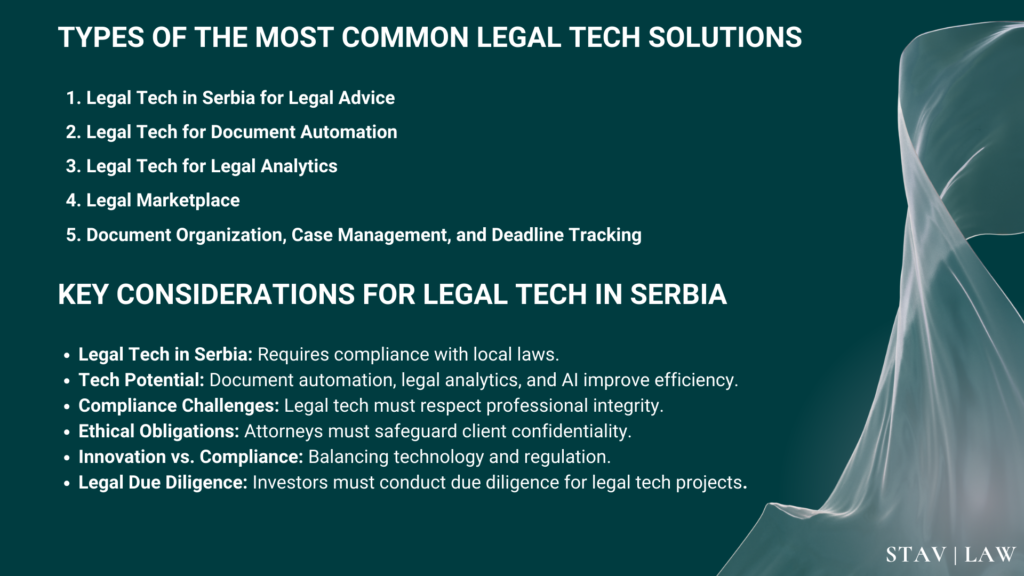
As the legal tech landscape evolves, attorneys in Serbia must navigate a complex regulatory environment. Technologies like document automation, legal analytics, and AI-based marketplaces offer significant potential to improve efficiency and accessibility in the legal field. However, the challenge lies in ensuring that these tools comply with the regulations that protect the exclusivity of legal assistance and maintain the integrity of the legal profession.
Attorneys should be mindful of their ethical and legal obligations, especially when it comes to client confidentiality and the risk of unauthorized practice. The key to success will be finding the right balance between embracing technological innovation and ensuring regulatory compliance.
Ultimately, one of the key considerations for investors and entrepreneurs, as with other tech projects, is the legal due diligence regarding the permissibility and feasibility of the project. Therefore, consulting a lawyer on matters related to legal tech is strongly advisable.
[1] Article 3 of the Legal Profession Law of the Republic of Serbia
[2] Article 342 of the Criminal Code of the Republic of Serbia
[3] Attorney Fee Schedule: https://www.paragraf.rs/propisi/tarifa_o_nagradama_i_naknadama_troskova_za_rad_advokata.html