

Crypto in Serbia is steadily gaining traction, fueled by increasing interest in blockchain technology and its diverse applications. Considering Serbia’s crypto-friendly policies, more people are investing in and using crypto in Serbia. In this blog, we’ll provide insights into how digital assets are regulated and how crypto taxation in Serbia works, covering essential information for both businesses and individual investors.
What You’ll Learn about Crypto in Serbia?
This blog post is tailored for those curious about crypto taxation in Serbia and how digital assets in Serbia are managed and regulated under Serbian law. We’ll explore which types of crypto in Serbia are recognized under the Digital Assets Law – Virtual Currencies and Digital Tokens. We’ll also touch upon how tax laws apply to crypto transactions for legal entities and individuals, making this guide ideal for anyone involved in the growing Serbian crypto market.
How is Crypto in Serbia Regulated?
Crypto assets in Serbia are regulated under the Digital Assets Law, which defines digital or virtual assets as digital records of value that can be bought, sold, exchanged, or transferred digitally. These assets can be used as an exchange medium or an investment vehicle, distinguishing them from legal currency or financial assets regulated under other laws.
Crypto assets in Serbia are divided into two main categories:
- Virtual Currencies (e.g., Bitcoin), which are typically used as a medium of exchange.
- Digital Tokens (e.g., NFTs), which may grant certain rights or services to its holder.
The National Bank of Serbia oversees virtual currencies, while the Serbian Securities Commission is responsible for digital tokens. In cases where a digital asset has both virtual currency and digital token characteristics, both institutions share jurisdiction.
Token Issuance and ICOs in Serbia
Is Crypto in Serbia Considered a Financial Instrument?
Digital assets in Serbia that resemble financial instruments, or securities, are subject to capital markets regulation, particularly in secondary markets and service provisions related to these assets.
The regulations on the capital markets shall not apply if digital assets meet all of the following conditions:
- The digital asset does not have the characteristics of shares;
- The digital asset is not exchangeable for shares;
- The total value of digital assets issued by a single issuer over a 12-month period does not exceed 3,000,000 EUR, calculated in dinar equivalent at the official middle exchange rate of the dinar to the euro determined by the National Bank of Serbia on the issuance date or during the primary sale.
In conclusion, if digital assets in Serbia meet the specified criteria, they are not subject to capital market regulations, providing greater flexibility for their issuance and trading in Serbia.
Whitepaper in Serbia
According to Serbian law, issuers are not obligated to create a whitepaper for their digital assets in Serbia, but the law does provide the option to issue one, offering relevant information to help investors make informed decisions. The white paper is approved by the relevant supervisory authority – National Bank of Serbia, and/or the Serbian Securities Commission.
The information provided in the white paper must be concise, clear, and comprehensible, and presented in a way that allows for easy analysis.
If no whitepaper is issued, the initial offering of digital assets in Serbia cannot be publicly advertised. Additionally, if a whitepaper is issued but not approved by the competent authority, it must be clearly stated that the whitepaper has not been officially approved.
Although issuing a whitepaper is not mandatory, it can be very useful, especially since, in most cases, issuing a whitepaper without advertising or promotion loses its purpose.
Providing Services Related to Crypto in Serbia
List of Crypto-Related Services in Serbia
A provider of services related to digital assets in Serbia (Crypto-Related Services) is authorized to offer these services after obtaining a license from the supervisory authority for providing digital asset-related services.
Crypto-Related Services in the Republic of Serbia Include:
- Receiving, transferring, and executing orders related to the purchase and sale of digital assets on behalf of third parties;
- Services for buying and selling digital assets for cash and/or account funds and/or electronic money;
- Services for exchanging one digital asset for another;
- Custody and administration of digital assets on behalf of digital asset users and related services;
- Services related to the issuance, offering, and sale of digital assets, with an obligation to repurchase (sponsorship) or without such an obligation (agency);
- Maintenance of a register of pledges on digital assets;
- Services for accepting/transferring digital assets;
- Digital asset portfolio management;
- Organization of a digital asset trading platform.
A provider of advisory services related to digital assets is not required to obtain a license from the supervisory authority to provide the advisory services.
Minimum Founding Capital of Crypto Service Providers in Serbia
- A minimum founding capital of EUR 20,000 is required for the first six services above.
- A founding capital of EUR 50,000 is required for the seventh and eighth service above.
- An investment of EUR 125,000 in founding capital is necessary for the ninth service above.
The minimum capital can be monetary and non-monetary (e.g., in software), with at least half of the minimum capital required to be registered and paid in monetary form. The provider of crypto-related services is also obligated to ensure that its capital is always maintained at a level that is not lower than the minimum required capital following the company formation in Serbia.
Is Your Crypto Business in Serbia Subject to AML Regulations?
In summary, if you offer and provide the crypto-related services mentioned above, you are required to comply with anti-money laundering (AML) regulations.
As a result, crypto service providers in Serbia, as stated above are subject to specific obligations under these regulations aimed at preventing money laundering and the financing of terrorism. These obligations are similar to those imposed on traditional financial institutions, ensuring that crypto service providers in Serbia take the necessary steps to monitor, report, and prevent illicit activities within the crypto space.
Can You Offer Crypto Services Internationally From Serbia?
Yes, you can! A provider of digital asset-related services has the ability to offer such services in a foreign country, either by establishing a branch or providing services directly, as long as they comply with the regulations of that country.
In order to establish a branch or provide digital asset-related services directly abroad, the service provider must submit an application to the relevant supervisory authority in Serbia for approval. This application must be accompanied by a couple of supporting documents, such as a detailed business plan, projections on the expected volume of customers and transactions, information about the individuals who will be managing these operations, and other relevant details.
The Serbian supervisory authority is required to make a decision on this request within 60 days. Once the approval is granted, the provider is authorized to begin offering services in the foreign country, in full compliance with the local regulatory framework.
Can Businesses and Individuals Use Crypto in Serbia?
Yes, both individuals and companies in Serbia have the freedom to own and use digital assets without restriction, provided they comply with the applicable laws and regulations governing digital assets. This means that individuals can freely invest in, trade, mine, and utilize digital currencies or other digital assets for personal use, while companies can incorporate them into their business models.
Businesses that choose to use digital assets in their operations have the flexibility to adopt accounting standards that best reflect the unique characteristics of these assets. This allows companies to accurately capture the nature of digital assets, whether they are used as investments, payments, or for other purposes. Businesses can select the most appropriate approach for financial reporting, ensuring transparency and alignment with both national and international accounting practices.
Consequently, this flexibility in reporting is particularly important for companies dealing with the dynamic and evolving nature of digital assets, as it helps them present a clearer financial picture while maintaining compliance with relevant regulations.
Tax on Crypto in Serbia
Serbia’s tax system recognizes digital assets in Serbia and includes distinct rules for crypto taxation in Serbia, both for companies and individuals:
Value-Added Tax on Crypto in Serbia (VAT)
Virtual currencies, such as Bitcoin, are exempt from VAT when transferred. However, VAT does not apply to digital tokens, so companies registered for VAT dealing in tokens that are linked to the sale of goods/services in Serbia must apply VAT to these transactions.
Corporate Tax on Crypto for Legal Entities
When a company acquires digital assets and later sells them at a profit, the difference between the acquisition and resale prices is considered revenue and must be recorded in the company’s business books. This capital gain is subject to the annual corporate tax, which in Serbia is set at a rate of 15%.
Certain tax reliefs are available for legal entities in Serbia if proceeds from the sale of digital assets are reinvested in Serbia within the tax period. Namely, capital gains realized from the sale of digital assets are not included in the tax base if the funds from that sale are invested in the capital of a resident taxpayer, or an investment fund, and whose center of business or investment activities is located within the territory of Serbia.
Capital Gains Tax on Crypto for Individuals
Individuals are subject to a 15% capital gains tax on crypto profits in Serbia. Gains are calculated by subtracting the acquisition price from the selling price of the digital asset. When a crypto holder generates income by exchanging cryptocurrency for FIAT or one crypto asset for another, the individual who has realized a capital gain is required to submit a tax declaration within 120 days after the quarter in which the gain was made. A tax declaration must be filed whether a capital gain or a capital loss is realized.
Tax reliefs are also available for individuals. Namely, individuals who sell digital assets and reinvest the proceeds into Serbian companies within 90 days can enjoy a 50% capital gains tax exemption. Even if the investment occurs after 90 days but within 12 months, a 50% tax refund is available.
Why Consider Serbia If You Are a Crypto Enthusiast?
If you’re still contemplating whether Serbia is the right location for your crypto business or other ventures, here are several compelling reasons to consider:
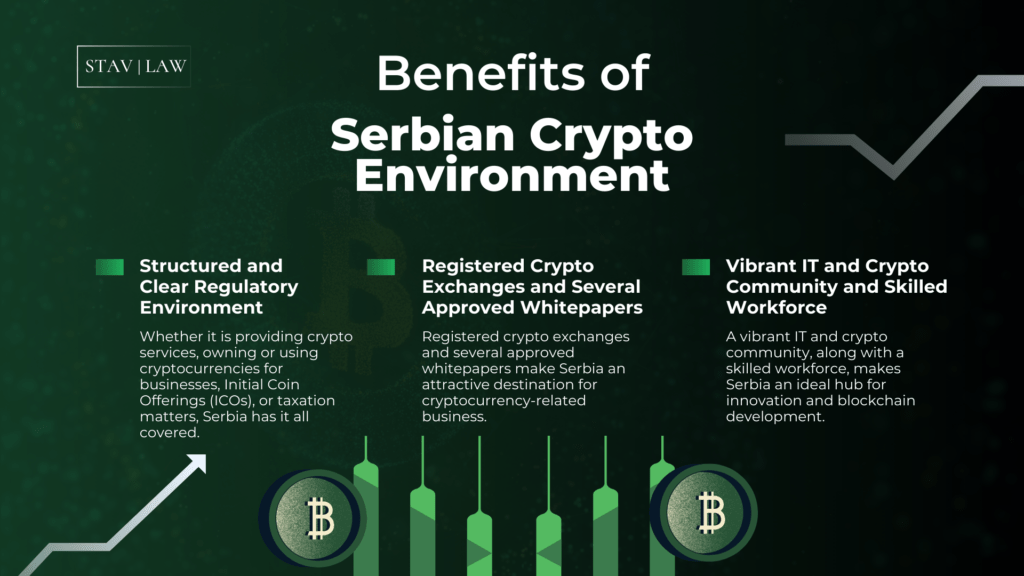
- Serbia offers a structured and favorable regulatory environment for crypto enthusiasts, providing clarity on crypto taxation and the general legal framework for crypto in Serbia.
- The Serbian National Bank has approved and registered two fully operational crypto exchanges[1].
- Serbian Securities Commission has approved several Whitepapers in Serbia[2].
- Serbia boasts a vibrant IT and crypto community, hosting numerous meet-ups and regional conferences.
Ultimately, for many individuals, entrepreneurs, and companies in Serbia, the crypto industry is a key area of involvement, whether as service providers, miners, or crypto owners. This makes Serbia an excellent hub for the growth of crypto businesses and a conducive environment for crypto owners to succeed.
If you are interested in starting a company in Serbia, as well as other advantages that Serbia offers to businesspeople, read our blog on the Top 10 Reasons for Company Registration in Serbia, along with a Detailed Guide to Company Formation in Serbia.
[1] National Bank of Serbia’s Register of Virtual Currency Service Providers: https://nbs.rs/en/ciljevi-i-funkcije/nadzor-nad-finansijskim-institucijama/digital-imo/reg_di/index.html
[2] Serbian Securities Commission’s Register of Approved Whitepapers: https://www.sec.gov.rs/index.php/en/public-registers-of-information/register-of-service-providers-related-to-digital-tokens-2